|
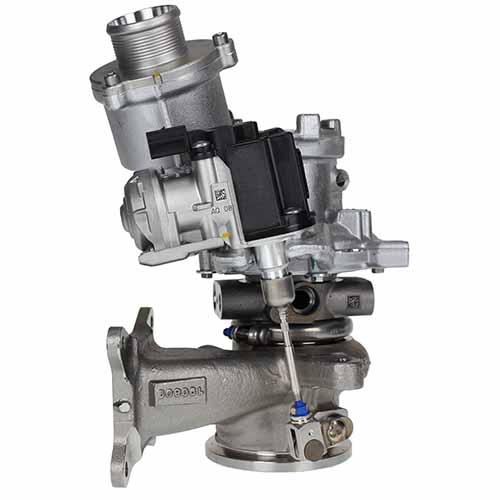
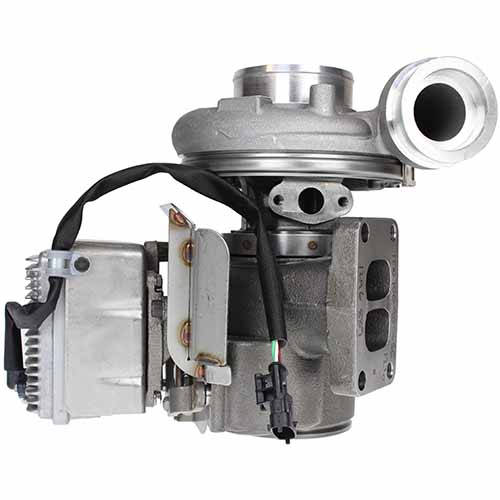
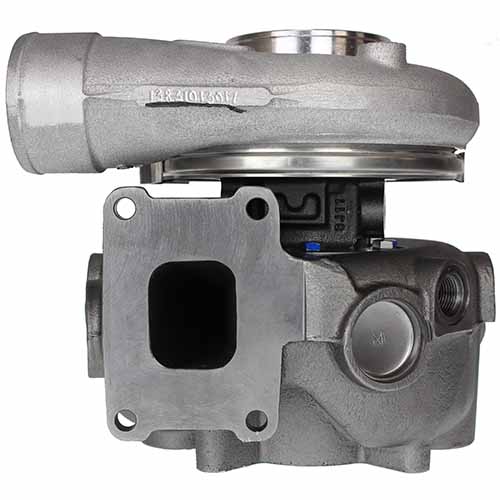
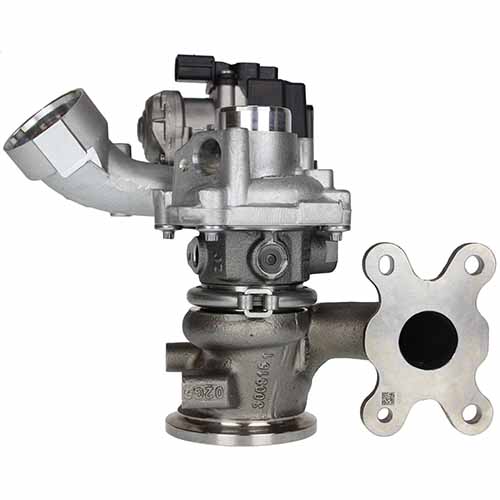
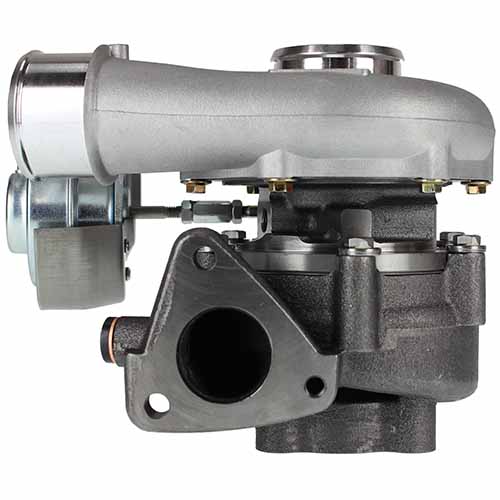
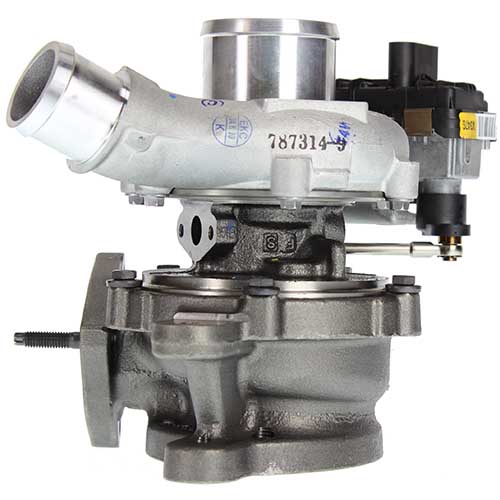
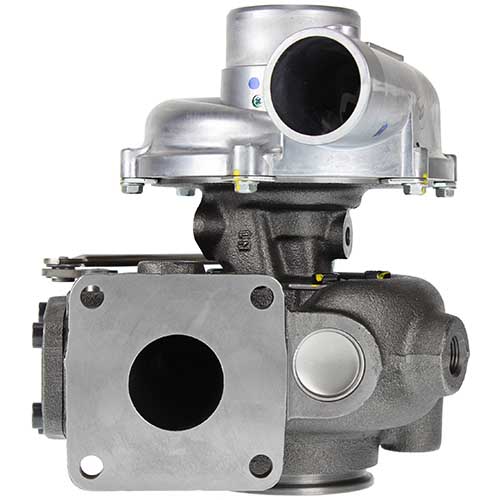
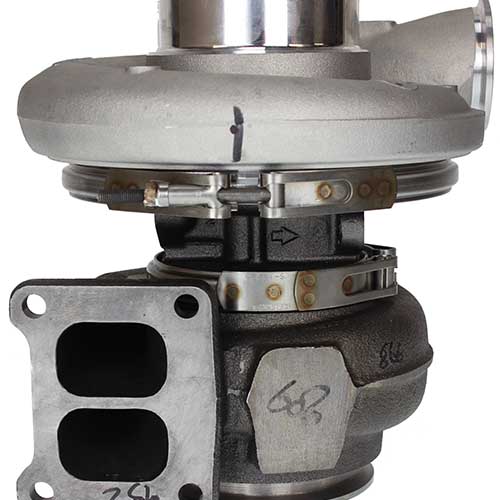
Turbocharger: an exhaust-driven intake air compressor. A turbocharger
consists of a compressor- and a turbine- wheel connected by a common shaft. The
exhaust-gas-driven turbine wheel supplies the drive energy for the compressor.
See also turbocharged engine diagramm.
The compressor increases the intake air density, and combined with additional
fuel, produces more power.
Turbo: is the short for Turbocharger.
Turbine:
The turbocharger turbine, which consists of a turbine wheel and a turbine
housing, converts the engine exhaust gas into mechanical energy to drive the
compressor.
The gas, which is restricted by the turbine's flow cross-sectional area,
results in a pressure and temperature drop between the inlet and outlet.
This pressure drop is converted by the turbine into kinetic energy to drive
the turbine wheel.
There are two main turbine types: axial and radial flow. In the axial-flow type,
flow through the wheel is only in the axial direction. In radial-flow turbines,
gas inflow is centripetal, i.e. in a radial direction from the outside in, and
gas outflow in an axial direction.
Up to a wheel diameter of about 160 mm, only radial-flow turbines are used. This
corresponds to an engine power of approximately 1000 kW per turbocharger. From
300 mm onwards, only axial-flow turbines are used. Between these two values,
both variants are possible.
As the radial-flow turbine is the most popular type for automotive applications,
the following description is limited to the design and function of this turbine
type. In the volute of such radial or centripetal turbines, exhaust gas pressure
is converted into kinetic energy and the exhaust gas at the wheel circumference
is directed at constant velocity to the turbine wheel. Energy transfer from
kinetic energy into shaft power takes place in the turbine wheel, which is
designed so that nearly all the kinetic energy is converted by the time the gas
reaches the wheel outlet.
Operating characteristics
The turbine performance increases as the pressure drop between the inlet and
outlet increases, i.e. when more exhaust gas is dammed upstream of the turbine
as a result of a higher engine speed, or in the case of an exhaust gas
temperature rise due to higher exhaust gas energy.
Compressor: Turbocharger compressors are generally centrifugal compressors
consisting of three essential components: compressor wheel, diffuser,
and housing. With the rotational speed of the wheel, air is drawn in
axially, accelerated to high velocity and then expelled in a radial
direction. The diffuser slows down the high-velocity air,
largely without losses, so that both pressure and temperature rise. The
diffuser is formed by the compressor backplate and a part of the volute
housing, which in its turn collects the air and slows it down further
before it reaches the compressor exit.
Bearing: Radial bearing system with a sleeve bearing, the shaft turns
without friction on an oil film in
the sleeve bearing bushing. For the turbocharger, the oil supply comes from
the engine oil circuit. The bearing system is designed such that brass
floating bushings, rotating at about half shaft speed, are situated between
the stationary centre housing and the rotating shaft. This allows these high
speed bearings to be adapted such that there is no metal contact between
shaft and bearings at any of the operating points. Besides the lubricating
function, the oil film in the bearing clearances also has a damping function,
which contributes to the stability of the shaft and turbine wheel assembly.
The hydrodynamic load-carrying capacity and the bearing damping
characteristics are optimised by the clearances. The lubricating oil
thickness for the inner clearances is therefore selected with respect to the
bearing strength, whereas the outer clearances are designed with regard to
the bearing damping. The bearing clearances are only a few hundredths of a
millimetre.
The one-piece bearing system is a special form of a
sleeve bearing system. The shaft turns within a stationary bushing, which is
oil scavenged from the outside. The outer bearing clearance can be designed
specifically for the bearing damping, as no rotation takes place.
Axial-thrust bearing system
Neither the fully floating bushing bearings nor the single-piece fixed
floating bushing bearing system support forces in axial direction. As the
gas forces acting on the compressor and turbine wheels in axial direction
are of differing strengths, the shaft and turbine wheel assembly is
displaced in an axial direction. The axial bearing, a sliding surface
bearing with tapered lands, absorbs these forces. Two small discs fixed on
the shaft serve as contact surfaces. The axial bearing is fixed in the
centre housing. An oil-deflecting plate prevents the oil from entering the
shaft sealing area.
Actuator:
The turbine-side bypass is the simplest form of boost pressure control. The
turbine size is chosen such that torque characteristic requirements at low
engine speeds can be met and good vehicle driveability achieved. With this
design, more exhaust gas than required to produce the necessary boost
pressure is supplied to the turbine shortly before the maximum torque is
reached. Therefore, once a specific boost pressure is achieved, part of the
exhaust gas flow is fed around the turbine via a bypass. The wastegate which
opens or closes the bypass is usually operated by a spring-loaded diaphragm
in response to the boost pressure.
Today, electronic boost pressure control systems are
increasingly used in modern passenger car diesel and petrol engines. When
compared with purely pneumatic control, which can only function as a
full-load pressure limiter, a flexible boost pressure control allows an
optimal part-load boost pressure setting. This operates in accordance with
various parameters such as charge air temperature, degree of timing advance
and fuel quality. The operation of the flap corresponds to that of the
previously described actuator. The actuator diaphragm is subjected to a
modulated control pressure instead of full boost pressure.
VNT / VTG Variable turbine geometry
The variable turbine geometry allows the turbine flow cross-section to be
varied in accordance with the engine operating point. This allows the entire
exhaust gas energy to be utilised and the turbine flow cross-section to be
set optimally for each operating point. As a result, the efficiency of the
turbocharger and hence that of the engine is higher than that achieved with
the bypass control.
Flow cross-section
control through variable guide vanes: VTG
Variable guide vanes between the volute housing and the turbine wheel have
an effect on the pressure build-up behaviour and, therefore, on the turbine
power output. At low engine speeds, the flow cross-section is reduced by
closing the guide vanes. The boost pressure and hence the engine torque rise
as a result of the higher pressure drop between turbine inlet and outlet. At
high engine speeds, the guide vanes gradually open. The required boost
pressure is achieved at a low turbine pressure ratio and the engine's fuel
consumption reduced. During vehicle acceleration from low speeds the guide
vanes close to gain maximum energy of the exhaust gas. With increasing speed,
the vanes open and adapt to the corresponding operating point.
Watercooling: Petrol engines, where the exhaust gas temperatures are
200 to 300 °C higher than in diesel engines, are generally equipped with
water-cooled centre housings. During operation of the engine, the centre
housing is integrated into the cooling circuit of the engine. After the
engine's shutdown, the residual heat is carried away by means of a small
cooling circuit, which is driven by a thermostatically controlled electric
water pump.
Sealing:
The centre housing must be sealed against the hot turbine exhaust gas and
against oil loss from the centre housing. A piston ring is installed in a
groove on the rotor shaft on both the turbine and compressor side. These
rings do not rotate, but are firmly clamped in the centre housing. This
contactless type of sealing, a form of labyrinth seal, makes oil leakage
more difficult due to multiple flow reversals, and ensures that only small
quantities of exhaust gas escape into the crankcase.
Oil drain:
The lubricating oil flows into the turbocharger at a pressure of
approximately 4 bar. As the oil drains off at low pressure, the oil drain
pipe diameter must be much larger than the oil inlet pipe. The oil flow
through the bearing should, whenever possible, be vertical from top to
bottom. The oil drain pipe should be returned into the crankcase above the
engine oil level. Any obstruction in the oil drain pipe will result in back
pressure in the bearing system. The oil then passes through the sealing
rings into the compressor and the turbine.
|